One Man's Opinion, The Crisis With Special Districts

One Man’s Opinion: Mariposa County Must Take Responsibility for Its Special Districts
By Stanley Bissmeyer
Mariposa County assumed responsibility for the water and sewer systems serving Coulterville and Lake Don Pedro roughly five decades ago. The purpose was to address public-health concerns, support community development and provide reliable management of essential infrastructure in rural, unincorporated communities.
In Coulterville, inadequate infrastructure had contributed to a building moratorium. Establishing a County Service Area helped permit development to resume. In Lake Don Pedro, county oversight was intended to ensure that wastewater facilities met environmental and public-health requirements.
County management also promised an important advantage: small rural systems could pool resources and receive professional oversight through the Department of Public Works. The county would manage operations, respond to emergencies and pursue funding for necessary improvements.
That was the promise. In my opinion, the present condition of these systems raises serious questions about whether that promise was kept.
How Did We Get Here?
Before Proposition 13 passed in 1978, local governments had greater authority to establish separate property-tax rates. Proposition 13 replaced that system with a uniform 1% property-tax levy, which counties distribute among cities, schools, special districts and other local agencies according to formulas established by state law.
In the early 1990s, California shifted substantial property-tax revenue from cities, counties and special districts into Educational Revenue Augmentation Funds, commonly known as ERAF. Whatever one thinks of that policy, the result was less locally controlled revenue for many public agencies.
Proposition 218, approved in 1996, strengthened taxpayer protections by requiring voter or property-owner approval for many taxes, assessments and property-related fees. It also gave ratepayers a formal process for protesting proposed increases.
These measures limited the county’s financial flexibility, but they do not fully explain decades of deferred maintenance, inadequate reserves and deteriorating infrastructure. Those are management and policy questions that deserve honest answers.
Ratepayers Are Being Asked to Carry the Burden
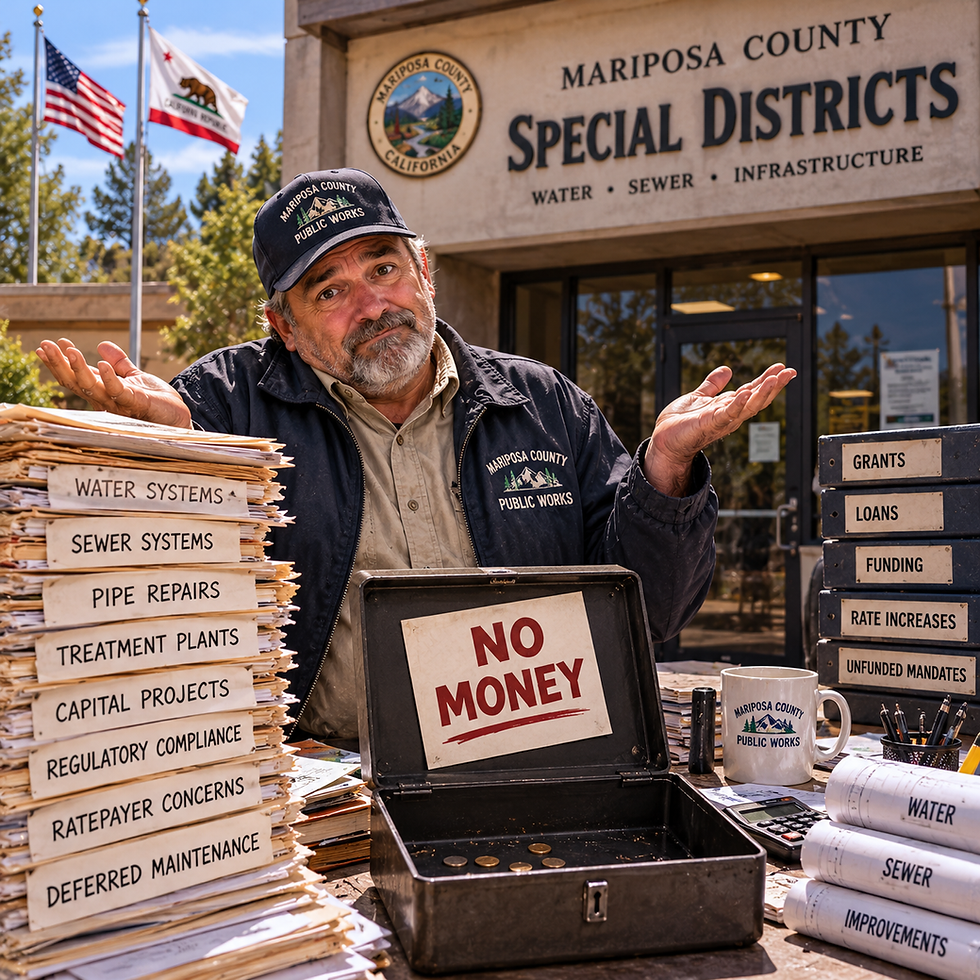
Property owners have opposed recent rate increases because they believe the proposed charges are simply unaffordable. In some cases, combined base water and sewer charges were projected to exceed $750 per month per household.
That is not a minor adjustment. For retirees, working families and residents living on fixed incomes, such a charge could threaten their ability to remain in their homes.
Ratepayers are also asking a fair question: If rates were held too low for many years and necessary maintenance was postponed, why should today’s residents be forced to correct decades of county decisions almost overnight?
The public deserves a complete accounting of:
All revenues collected from each district.
Property-tax allocations received on behalf of the districts.
Loans, transfers and administrative charges imposed by the county.
Maintenance and capital improvements completed or deferred.
Reserve balances and how those reserves were used.
Grant opportunities pursued, received or missed.
Warnings given to the Board of Supervisors about deteriorating infrastructure.
Until those records are clearly presented, residents cannot know how much of the current crisis resulted from inadequate rates, county management decisions, state funding changes or some combination of all three.
Receivership Is Not an Acceptable Plan
An insolvent water or sewer district cannot simply close its doors. These systems provide essential public services. Financial failure could lead to restructuring, consolidation, dissolution, court involvement or some form of outside administration.
Any such intervention could reduce local control. It could also bring higher rates, mandatory improvements and decisions made by officials who do not live in the affected communities.
I do not claim to know whether the county deliberately allowed these systems to deteriorate. Intent should not be alleged without evidence. However, the outcome is undeniable: critical infrastructure is aging, ratepayers face potentially devastating increases and the districts’ financial future is uncertain.
Whether this condition resulted from neglect, poor planning, inadequate revenue or a lack of political will, responsibility should not be placed entirely on current property owners.
A Different Solution
I believe Mariposa County should begin by acknowledging its own role in managing these systems.
First, the county should conduct—or authorize—an independent financial and operational review of each district. The findings should be presented publicly in language residents can understand.
Second, the county should examine forgiving or restructuring district debt owed to the county, particularly where that debt resulted from deferred maintenance or earlier county management decisions. Ratepayers should not be charged interest indefinitely for failures they did not cause.
Third, the county should provide temporary stabilization funding. That could include an appropriate combination of available property-tax revenue, discretionary funds, surplus revenue or Transient Occupancy Tax revenue, subject to legal restrictions and public budget priorities.
This assistance should not become a permanent blank check. It should serve as a bridge while the districts pursue state and federal grants, low-interest infrastructure loans and other capital funding.
Fourth, future rate increases should be gradual, transparent and tied to a publicly adopted capital-improvement plan. Adjustments should reflect actual operating costs and reasonable inflation—not decades of deferred expenses imposed all at once.
Finally, the county must establish measurable standards for Public Works. Maintenance schedules, reserve requirements, system conditions, project deadlines and financial reports should be presented regularly to the Board of Supervisors and the affected communities.
Reconsidering the Enterprise Model
Enterprise Districts are generally expected to support themselves primarily through customer charges. That approach may work in larger communities with many ratepayers. It can become unrealistic in small rural districts where a limited number of households must support expensive water and sewer infrastructure.
Mariposa County should examine whether these services must continue operating solely under the enterprise model or whether another lawful district structure could combine reasonable user fees with an appropriate share of tax revenue.
Water and sewer systems protect public health, property values, housing and economic development. Their benefits extend beyond the customers who receive a monthly bill.
In my opinion, simply declaring that each district must pay its own way ignores the county’s history of ownership, oversight and management. Mariposa County assumed responsibility for these systems to protect the public and support rural communities. It cannot walk away when the infrastructure reaches the end of its useful life.
The answer is not bankruptcy, receivership or unaffordable rates. The answer is transparency, shared responsibility, outside funding, accountable management and a realistic long-term plan.
That is one man’s opinion—but I believe the people who live in these districts deserve nothing less.


Comments